As a supplier of pillar jib cranes, I often encounter inquiries from customers about the functionality and versatility of our products. One common question that arises is whether a pillar jib crane can be used for lifting items at different angles. In this blog post, I will delve into this topic and provide a comprehensive answer based on the technical capabilities and design features of our pillar jib cranes.
Understanding the Basics of a Pillar Jib Crane
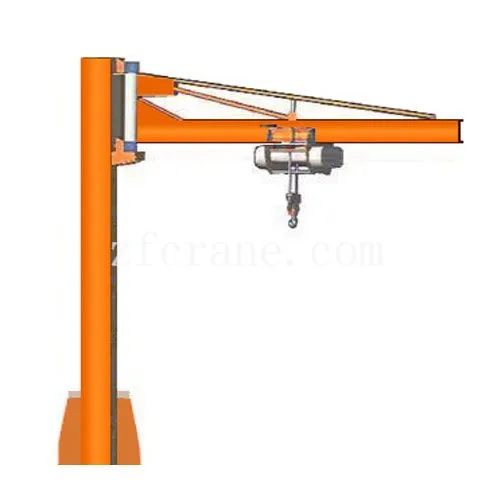
Before we discuss the ability to lift items at different angles, it's essential to understand the basic structure and operation of a pillar jib crane. A pillar jib crane consists of a vertical pillar that is fixed to the floor or a foundation. Attached to the top of the pillar is a horizontal jib arm, which can rotate around the pillar. The jib arm is equipped with a hoist or a lifting device that can move along the length of the arm.
The primary advantage of a pillar jib crane is its ability to provide a wide range of lifting coverage within a limited area. The rotating jib arm allows the crane to reach different points within its working radius, making it ideal for applications where items need to be lifted and moved in a circular or semi - circular pattern.
Lifting at Different Angles: Technical Feasibility
The short answer is yes, a pillar jib crane can be used for lifting items at different angles. This is primarily due to two key design features: the rotation of the jib arm and the movement of the hoist along the arm.
Rotation of the Jib Arm
The jib arm of a pillar jib crane can rotate 360 degrees around the vertical pillar in most cases. This rotation allows the crane to approach the item to be lifted from various angles. For example, if an item is located at an angle relative to the initial position of the jib arm, the operator can simply rotate the arm to align it with the item. This flexibility is crucial in industrial settings where the layout of the workspace may require the crane to access items from different directions.

Movement of the Hoist along the Arm
The hoist on a pillar jib crane can move along the length of the jib arm. This movement, combined with the rotation of the arm, enables the crane to lift items at different angles relative to the vertical axis. When the hoist is positioned at different points along the arm, the angle of the lifting force can be adjusted. For instance, if the hoist is closer to the pillar, the lifting angle will be different compared to when it is at the end of the arm.
Factors Affecting Lifting at Different Angles
While a pillar jib crane is capable of lifting items at different angles, there are several factors that need to be considered to ensure safe and efficient operation.
Load Capacity
The load capacity of a pillar jib crane can vary depending on the angle of the lift. When lifting at an angle, the effective load on the crane may increase due to the additional forces acting on the jib arm and the hoist. It's crucial to consult the crane's load chart, which provides information on the maximum load capacity at different angles and positions along the jib arm. Exceeding the recommended load capacity can lead to structural damage to the crane and pose a significant safety risk.
Stability
Lifting at different angles can affect the stability of the pillar jib crane. When the jib arm is extended at an angle, the center of gravity of the crane - load system changes. To maintain stability, the crane must be properly installed and anchored to a solid foundation. Additionally, the operator should be aware of the crane's stability limits and avoid making sudden or excessive movements that could cause the crane to tip over.
Obstructions
In a real - world industrial environment, there may be obstructions such as machinery, walls, or other equipment that can limit the ability to lift items at certain angles. The operator needs to carefully assess the workspace and plan the lift to avoid collisions with these obstructions. Some pillar jib cranes are designed with features such as anti - collision devices to enhance safety in such situations.
Applications of Lifting at Different Angles
The ability to lift items at different angles makes pillar jib cranes suitable for a wide range of applications.
Manufacturing
In manufacturing plants, pillar jib cranes are used to lift and move components between different workstations. The ability to approach the components from different angles allows for more efficient assembly processes. For example, in an automotive manufacturing plant, a pillar jib crane can be used to lift engine blocks and place them at the correct angle for installation into the vehicle chassis.
Warehousing
In warehousing facilities, pillar jib cranes can be used to load and unload items from storage racks at different angles. This is particularly useful when dealing with irregularly shaped or oversized items that cannot be easily accessed from a single direction.
Construction
On construction sites, pillar jib cranes can be used to lift building materials such as steel beams and concrete blocks at different angles. This flexibility allows the crane to work in confined spaces and adapt to the changing layout of the construction site.
Our Pillar Jib Crane Solutions
At our company, we offer a range of Pillar-mounted Slewing Jib Crane that are designed to provide maximum flexibility in lifting operations. Our cranes are engineered with high - quality materials and advanced technology to ensure reliable performance and safety.
Our pillar jib cranes feature smooth rotation of the jib arm and precise movement of the hoist, allowing for easy adjustment of the lifting angle. We also provide detailed load charts and installation instructions to help our customers operate the cranes safely and efficiently.
Contact Us for Your Lifting Needs
If you are looking for a reliable and versatile pillar jib crane for your lifting requirements, we would be delighted to assist you. Our team of experts can provide you with detailed information about our products, including specifications, pricing, and installation options. Whether you need a crane for a small workshop or a large industrial facility, we have the right solution for you.
Contact us today to start a discussion about your specific needs and explore how our pillar jib cranes can enhance your lifting operations.
References
- Crane Manufacturers Association of America (CMAA). Crane Design Standards.
- Occupational Safety and Health Administration (OSHA). Crane Safety Guidelines.
- Machinery's Handbook, 31st Edition. Industrial Press Inc.