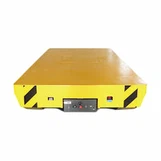
Hey there! I'm a supplier of KPJ transfer trolleys, and I've been getting a lot of questions lately about how the speed of these trolleys varies with the load. So, I thought I'd take a moment to share some insights on this topic.
First off, let's talk a bit about what KPJ transfer trolleys are. These are nifty pieces of equipment used in various industrial settings to move heavy loads from one place to another. You can check out more about KPJ Rail Transfer Trolley and KPJ Electric Transfer Trolley on our website. They're designed to be reliable, efficient, and easy to operate, making them a popular choice for many businesses.
Now, onto the main question: how does the speed of a KPJ transfer trolley change with the load? Well, it's not a one - size - fits - all answer, but there are some general principles at play.
The Basics of Trolley Speed and Load
When a KPJ transfer trolley is running with no load, it can usually reach its maximum speed. This is because there's less resistance to overcome. The motor doesn't have to work as hard to move the trolley forward, so it can operate at a relatively high speed. For example, in an empty state, a typical KPJ transfer trolley might be able to zip along at a speed of around 20 - 30 meters per minute, depending on the model.
But as you start adding load to the trolley, things start to change. The extra weight creates more friction between the wheels and the rail, and it also puts more strain on the motor. This means that the motor has to work harder to maintain the same level of movement. As a result, the speed of the trolley starts to decrease.


Factors Affecting the Relationship
There are a few factors that can affect how much the speed drops as the load increases.
Motor Power
The power of the motor in the KPJ transfer trolley is a crucial factor. A more powerful motor can handle heavier loads with less of a speed reduction. For instance, if you have a trolley with a high - power motor, it might only see a small drop in speed when you add a moderate load. Let's say you have a 10 - ton capacity trolley with a powerful motor. When you load it up with 3 tons, the speed might only decrease from 25 meters per minute to 20 meters per minute. On the other hand, a trolley with a less powerful motor will experience a more significant speed reduction under the same load.
Wheel and Rail Conditions
The condition of the wheels and the rail also matters. If the wheels are well - maintained and the rail is smooth, there will be less friction. This means that the trolley can move more easily, even with a load. However, if the wheels are worn out or the rail is damaged, the friction will increase. This can cause a more substantial drop in speed as the load is added. For example, if the rail has some bumps or the wheels are not properly aligned, the trolley might slow down more than expected when a load is placed on it.
Trolley Design
The design of the KPJ transfer trolley itself can impact the speed - load relationship. Some trolleys are designed with features that help them handle loads more efficiently. For example, trolleys with a better weight - distribution system can spread the load more evenly across the wheels. This reduces the stress on individual components and can result in a smaller speed reduction as the load increases.
Real - World Examples
Let's look at a couple of real - world scenarios to see how this all plays out.
Light Load Scenario
Suppose you're using a KPJ transfer trolley to move small parts in a factory. You're only loading it up with about 1 - 2 tons, which is a relatively light load for a medium - sized trolley. In this case, the speed reduction might be quite minimal. You might notice that the trolley goes from its empty speed of 25 meters per minute to around 22 meters per minute. This small drop in speed is usually not a big deal, and it won't significantly affect your operations.
Heavy Load Scenario
Now, imagine you're using the same trolley to move a large, heavy machine that weighs around 8 tons. This is close to the maximum capacity of the trolley. Here, you'll see a much more significant speed reduction. The speed might drop from 25 meters per minute to 10 - 12 meters per minute. This is because the motor is really struggling to move the heavy load, and the friction between the wheels and the rail is much higher.
Calculating Speed Changes
In some cases, you might want to be able to calculate how much the speed of the KPJ transfer trolley will change with a given load. While there's no exact formula that works for every situation, you can make some rough estimates.
One way to do this is to look at the power - to - weight ratio of the trolley. You can calculate the power of the motor (usually given in kilowatts) and divide it by the total weight of the loaded trolley. A lower power - to - weight ratio generally means a bigger speed reduction.
Let's say you have a motor with a power of 5 kilowatts. When the trolley is empty, it weighs 2 tons. So the power - to - weight ratio is 5 / 2 = 2.5 kilowatts per ton. Now, if you load it up with an additional 5 tons, the total weight becomes 7 tons. The new power - to - weight ratio is 5 / 7 ≈ 0.71 kilowatts per ton. As you can see, this ratio has decreased significantly, which indicates that the speed is likely to drop.
Managing Speed and Load in Your Operations
As a user of KPJ transfer trolleys, it's important to understand how the speed and load interact so that you can plan your operations effectively.
If you need to move heavy loads quickly, you might want to consider using a trolley with a more powerful motor. This will help minimize the speed reduction and keep your workflow moving smoothly.
On the other hand, if you're dealing with mostly light loads, you can probably get away with a smaller - motor trolley. This can save you on costs without sacrificing too much in terms of performance.
Conclusion
In conclusion, the speed of a KPJ transfer trolley definitely varies with the load. As the load increases, the speed generally decreases due to increased friction and strain on the motor. However, factors like motor power, wheel and rail conditions, and trolley design can all influence how much the speed drops.
If you're in the market for a KPJ transfer trolley or you have more questions about how they perform under different loads, don't hesitate to reach out. We're here to help you find the right solution for your business needs. Whether you need a high - speed trolley for light loads or a heavy - duty one for moving large equipment, we've got you covered. Contact us to start a discussion about your requirements and let's see how we can make your operations more efficient.
References
- Industrial Material Handling Equipment Handbook
- Studies on Electric Trolley Performance in Different Load Conditions
So, that's a wrap on how the speed of a KPJ transfer trolley varies with the load. I hope this blog post has been helpful to you. If you have any more questions or want to learn more, feel free to drop me a line!