What is the rotation angle of a pillar jib crane?
As a supplier of pillar jib cranes, I often encounter customers who are curious about various aspects of our products, and one frequently asked question is about the rotation angle of a pillar jib crane. In this blog post, I will delve into this topic in detail, exploring the factors that influence the rotation angle, typical rotation angles available in the market, and the significance of this parameter in different applications.
Understanding the Basics of Pillar Jib Cranes
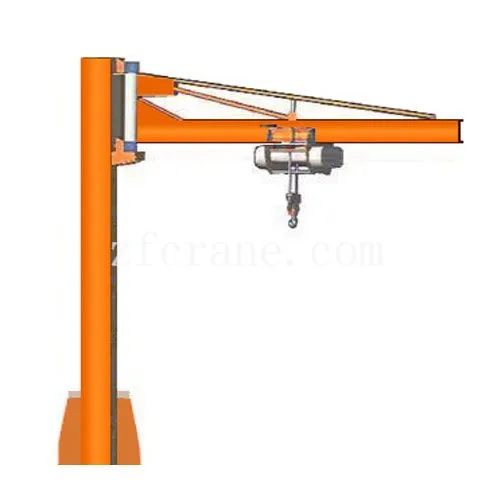
Before we discuss the rotation angle, it's essential to have a basic understanding of what a pillar jib crane is. A pillar jib crane, also known as a Pillar-mounted Slewing Jib Crane, is a type of crane that is fixed to a pillar or a column. It consists of a horizontal jib or boom that can rotate around a vertical axis, allowing it to move loads in a circular or semi - circular area. These cranes are widely used in industrial settings such as workshops, warehouses, and manufacturing plants for lifting and moving heavy objects with relative ease.
Factors Influencing the Rotation Angle
The rotation angle of a pillar jib crane is not a fixed value and can be influenced by several factors:
Crane Design
The physical design of the crane plays a crucial role in determining its rotation angle. The internal gear mechanism, the connection between the jib and the pillar, and the overall structural layout all impact how far the jib can rotate. For example, some cranes are designed with a full 360 - degree rotation capability, which requires a more complex and robust gear system to ensure smooth and stable operation. On the other hand, semi - circular or limited - rotation cranes may have a simpler design and are often more cost - effective.

Installation Environment
The environment where the pillar jib crane is installed also affects its rotation angle. If there are obstacles such as walls, columns, or other machinery in the vicinity, the crane's rotation may be restricted. For instance, in a small workshop with limited space, a full 360 - degree rotation may not be feasible due to the proximity of equipment or structures. In such cases, a crane with a reduced rotation angle, such as 270 degrees or 180 degrees, may be more appropriate.
Load Capacity
The load capacity of the crane can also influence the rotation angle. Heavier loads require more stability and support during rotation. A crane designed to lift extremely heavy loads may have a more limited rotation angle to ensure the safety and integrity of the structure. This is because a wider rotation angle can increase the stress on the crane's components, especially when carrying large weights.
Typical Rotation Angles
In the market, there are several common rotation angles available for pillar jib cranes:
180 - Degree Rotation
A 180 - degree pillar jib crane is ideal for applications where the load needs to be moved between two relatively fixed positions on either side of the pillar. This type of crane is often used in situations where the workspace is narrow and there is no need for a full - circle rotation. For example, in a loading dock where trucks are parked on one side and storage racks are on the other, a 180 - degree crane can efficiently transfer goods between the two areas.
270 - Degree Rotation
A 270 - degree rotation provides a wider working area than a 180 - degree crane. It is suitable for applications where a larger arc of movement is required, but a full 360 - degree rotation is not necessary or practical. This type of crane can be used in manufacturing cells where multiple workstations are arranged in a semi - circular pattern around the pillar.
360 - Degree Rotation
A 360 - degree pillar jib crane offers the maximum flexibility in terms of movement. It allows the crane to access any point within its reach in a full circular area. This is highly beneficial in applications where the load needs to be moved to various locations around the pillar, such as in a large workshop with multiple assembly stations or in a storage yard where goods are stored in a circular layout.
Significance of Rotation Angle in Different Applications
The rotation angle of a pillar jib crane is a critical parameter that can significantly impact its performance and suitability for different applications:
Efficiency
A crane with an appropriate rotation angle can improve the efficiency of material handling operations. For example, in a production line, a 360 - degree crane can quickly transfer materials between different workstations without the need for re - positioning, reducing downtime and increasing productivity.
Safety
The rotation angle also affects the safety of the crane operation. If the rotation angle is not properly matched to the installation environment, there is a risk of the crane colliding with obstacles, which can cause damage to the crane, the load, or even pose a threat to the operators. Therefore, it's essential to carefully consider the rotation angle based on the specific safety requirements of the application.
Cost - Effectiveness
Selecting a crane with the right rotation angle can also lead to cost savings. A crane with a larger rotation angle may be more expensive, but it may also eliminate the need for additional cranes or re - handling equipment. On the other hand, choosing a crane with a smaller rotation angle when it is sufficient for the job can help reduce the initial investment and operating costs.
Choosing the Right Rotation Angle for Your Needs
When choosing a pillar jib crane, it's important to assess your specific requirements carefully. Consider the following steps:
Evaluate Your Workspace
Measure the available space in your workshop or facility and identify any potential obstacles that may limit the crane's rotation. This will help you determine the maximum rotation angle that is feasible.
Analyze Your Load Handling Requirements
Consider the type of loads you need to lift, their weight, and the frequency of movement. If you need to move loads to multiple locations around the pillar, a 360 - degree crane may be the best choice. However, if your operations are more focused on two or three specific areas, a limited - rotation crane may be sufficient.
Consult with a Professional
As a pillar jib crane supplier, we have extensive experience in helping customers select the right equipment. Our team of experts can provide valuable advice based on your specific needs and circumstances. We can assist you in calculating the required rotation angle, load capacity, and other important parameters to ensure that you get a crane that meets your requirements.
In conclusion, the rotation angle of a pillar jib crane is a vital factor that should be carefully considered when purchasing a crane. It affects the efficiency, safety, and cost - effectiveness of your material handling operations. Whether you need a 180 - degree, 270 - degree, or 360 - degree crane, we are here to help you make the right choice. If you are interested in learning more about our pillar jib cranes or have any questions regarding the rotation angle or other specifications, please don't hesitate to contact us for a detailed consultation. We look forward to partnering with you to meet your material handling needs.
References
- Industrial Machinery Handbook
- Crane Manufacturing Standards and Guidelines
- Published Research on Material Handling Equipment