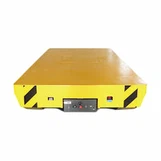
Hey there! As an AGV supplier, I've got a ton of experience in programming these nifty automated guided vehicles. Today, I'm gonna walk you through the process of programming an AGV, sharing some tips and tricks along the way.
Understanding the Basics of AGV Programming
First things first, let's talk about what an AGV is. An Automated Guided Vehicle is a self - navigating vehicle that moves materials around a facility without the need for a human operator. They're used in all sorts of industries, from manufacturing to warehousing, to improve efficiency and reduce labor costs.
Before you start programming, you need to understand the hardware of the AGV. It usually consists of a chassis, motors, sensors, and a control unit. The sensors are crucial as they help the AGV "see" its environment. Common sensors include laser scanners, cameras, and proximity sensors.

Selecting the Right Programming Language
There are several programming languages you can use to program an AGV. The choice depends on the complexity of the tasks and the capabilities of the AGV's control system.
- Python: It's a popular choice because it's easy to learn and has a large number of libraries. For example, you can use the
NumPylibrary for numerical calculations andOpenCVfor computer vision tasks if your AGV is equipped with cameras. - C/C++: These languages are more low - level and offer better performance. They're great for tasks that require real - time control, like motor control and sensor data processing.
Defining the AGV's Tasks
The next step is to figure out what tasks the AGV needs to perform. This could be something as simple as moving from point A to point B or as complex as picking up and dropping off items at multiple locations.
Let's say you want the AGV to move along a pre - defined path. You'll need to define the coordinates of the path. You can use a coordinate system based on the layout of your facility. For example, if your facility is a warehouse, you can use the rows and columns of the storage racks as a reference.
Programming the AGV's Movement
Path Planning
Path planning is a key part of AGV programming. You need to find the shortest and safest path for the AGV to reach its destination. There are several algorithms you can use for path planning:
- A Algorithm*: This is a popular algorithm for finding the shortest path in a graph. It takes into account the distance between nodes and an estimated cost to reach the goal. You can represent the layout of your facility as a graph, where the nodes are points on the floor and the edges are the possible paths between the points.
- Dijkstra's Algorithm: Similar to the A* algorithm, but it doesn't use an estimated cost to the goal. It simply finds the shortest path from a starting node to all other nodes in the graph.
Here's a simple example of how you might implement the A* algorithm in Python:
import heapq

def heuristic(a, b):
    return abs(a[0] - b[0]) + abs(a[1] - b[1])

def a_star(array, start, goal):
    neighbors = [(0, 1), (0, -1), (1, 0), (-1, 0)]
    close_set = set()
    came_from = {}
    gscore = {start: 0}
    fscore = {start: heuristic(start, goal)}
    oheap = []

    heapq.heappush(oheap, (fscore[start], start))

    while oheap:
        current = heapq.heappop(oheap)[1]

        if current == goal:
            data = []
            while current in came_from:
                data.append(current)
                current = came_from[current]
            return data

        close_set.add(current)
        for i, j in neighbors:
            neighbor = current[0] + i, current[1] + j
            tentative_g_score = gscore[current] + heuristic(current, neighbor)
            if 0 <= neighbor[0] < len(array):
                if 0 <= neighbor[1] < len(array[0]):
                    if array[neighbor[0]][neighbor[1]] == 1:
                        continue
                else:
                    # array bound y walls
                    continue
            else:
                # array bound x walls
                continue

            if neighbor in close_set and tentative_g_score >= gscore.get(neighbor, 0):
                continue

            if tentative_g_score < gscore.get(neighbor, 0) or neighbor not in [i[1] for i in oheap]:
                came_from[neighbor] = current
                gscore[neighbor] = tentative_g_score
                fscore[neighbor] = tentative_g_score + heuristic(neighbor, goal)
                heapq.heappush(oheap, (fscore[neighbor], neighbor))

    return None
Motor Control
Once you have a path planned, you need to control the AGV's motors to follow the path. The control system of the AGV usually has a motor driver that can be controlled by sending commands.
If you're using a microcontroller to control the AGV, you can use Pulse Width Modulation (PWM) to control the speed of the motors. PWM works by varying the width of the pulses sent to the motor driver, which in turn controls the average voltage applied to the motor.
Here's a simple example of how you might control a motor using PWM in Arduino (which uses C/C++):
const int motorPin = 9;

void setup() {
  pinMode(motorPin, OUTPUT);
}

void loop() {
  // Set the motor speed to 50%
  analogWrite(motorPin, 128);
  delay(1000);
  // Set the motor speed to 100%
  analogWrite(motorPin, 255);
  delay(1000);
}
Handling Obstacles
One of the challenges in AGV programming is handling obstacles. The AGV needs to be able to detect obstacles in its path and either avoid them or stop safely.
Obstacle Detection
As mentioned earlier, sensors like laser scanners and cameras can be used for obstacle detection. A laser scanner emits laser beams and measures the time it takes for the beams to bounce back. If there's an obstacle in the path, the time of flight will be shorter.
Cameras can also be used to detect obstacles. You can use computer vision techniques to analyze the images captured by the camera and identify objects in the scene.
Obstacle Avoidance
Once an obstacle is detected, the AGV needs to avoid it. One way to do this is to re - plan the path. You can use the same path planning algorithms mentioned earlier, but with updated information about the obstacle.
Another approach is to use a reactive control strategy. For example, if the AGV detects an obstacle on its left, it can turn right to avoid it.
Programming for Specialized Tasks
Load Handling
If your AGV is designed to handle loads, like a Heavy Load Laser Guided Vehicle, you need to program the load handling mechanism. This could involve controlling a robotic arm or a conveyor belt.
You'll need to define the actions for picking up and dropping off the load. For example, if the AGV is using a robotic arm, you need to program the movement of the arm's joints to reach the load and grip it.
Communication with Other Systems
In a real - world scenario, the AGV may need to communicate with other systems in the facility, like a Warehouse Management System (WMS). You can use protocols like Modbus or Ethernet/IP for communication.
For example, the WMS can send tasks to the AGV, and the AGV can send its status back to the WMS.
Conclusion
Programming an AGV is a complex but rewarding task. It involves understanding the hardware, selecting the right programming language, defining tasks, planning paths, controlling motors, handling obstacles, and programming for specialized tasks.
If you're looking to integrate AGVs into your operations, we're here to help. Whether you need a basic AGV for simple material handling or a heavy - duty Heavy Load Laser Guided Vehicle, we've got the expertise to program and customize the AGVs to meet your specific needs. Contact us to start a discussion about your requirements and see how we can optimize your workflow with our AGV solutions.
References
- "Artificial Intelligence: A Modern Approach" by Stuart Russell and Peter Norvig
- "Programming Robots with ROS" by Morgan Quigley, Brian Gerkey, and William D. Smart
- Arduino documentation: https://www.arduino.cc/reference/en/