

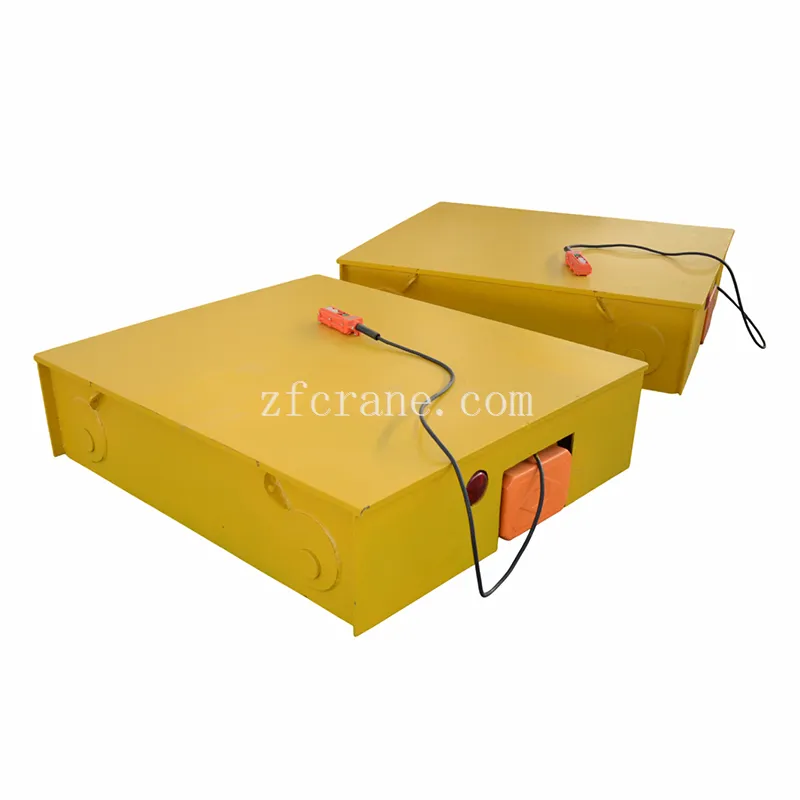


Description
Automated Guided Vehicles, commonly abbreviated as AGVs and also referred to as AGV trolleys, are a category of driverless industrial transport vehicles. Fitted with electromagnetic or optical autonomous navigation systems, they operate along pre-defined travel paths, come with built-in safety protection features, and perform diverse material handling tasks.
In industrial scenarios, these unmanned carriers run on rechargeable battery power. Their travel routes and operating behaviors can be centrally programmed via a computer system; alternatively, they navigate using electromagnetic tracks affixed to facility floors, drawing all movement and action signals directly from the data transmitted through these tracks.
An automated guided vehicle (AGV), different from an autonomous mobile robot (AMR), is a portable robot that follows along marked long lines or wires on the floor, or uses radio waves, vision cameras, magnets, or lasers for navigation. They are most often used in industrial applications to transport heavy materials around a large industrial building, such as factories or warehouses.
AGVs can tow objects behind them on trailers, and they can autonomously attach to those trailers. Trailers can be used to transport raw materials or finished products. AGVs can also store objects on a platform. Objects can be placed on a set of powered rollers (conveyor belts) and pushed off by reversing. AGVs are used in nearly all industries, including pulp, paper, metal, newspaper, and general manufacturing. They are also used in hospitals to transport supplies such as food, linens, or medications.
There are various models of AGVs available, suitable for moving products on assembly lines, transporting goods throughout factories or warehouses, and delivering loads.
Advantages
1. High Degree of Automation. Controlled by computers, electronic control devices, magnetic induction SENSOR, laser reflector, etc.
2. Automated Charging. The AGV's battery life is long (over 2 years), and it can operate for about 4 hours after a 15-minute charging.
3. Enhancing Corporate Image. AGVs are aesthetically pleasing and have high visibility.
4. Convenience and Space Saving. AGVs in the production workshop can shuttle back and forth across various workshops.
Quality Control System
1. New Employee Training
All new hires undergo standardized onboarding covering production workflows, equipment operation protocols, and quality benchmarks to ensure consistent output.
2. Raw Material Checks
- Supplier vetting: We qualify vendors through rigorous audits before procurement.
- Incoming inspection: Every batch of materials is tested for compliance, with non-conforming items rejected.
- Storage compliance: Accepted materials are logged and stored under documented conditions (e.g., temperature, humidity) to prevent degradation.
3. Design Validation
The Chief Engineer personally reviews and signs off on all design blueprints and product specs, cross-checking against regulatory/industry standards (e.g., ISO, ANSI) before production begins.
4. In-Process Quality Checks
A tiered inspection system is enforced at each production stage:
- Operator self-check (immediate verification after task completion)
- Peer review (team lead confirms critical parameters)
- QC audit (dedicated inspectors sample units hourly/daily using calibrated tools).
5. Pre-Shipment Verification
Finished goods undergo:
- Visual inspection (surface defects, assembly integrity)
- Functional testing (performance under simulated use)
- Safety validation (e.g., electrical safety, load-bearing capacity)
Only products passing all criteria receive certification for delivery.


Company Appearance


Hot Tags: automated guided vehicle, China automated guided vehicle manufacturers, suppliers, factory, Heavy Load Laser Guided Vehicle, agv, Automated Guided Vehicle


