Hey there! As a boom lift supplier, I've been dealing with these amazing machines for quite some time. Boom lifts are super useful in a bunch of industries, like construction, maintenance, and tree care. They let workers reach high places safely and efficiently. In this blog, I'm gonna break down the different parts of a boom lift so you can get a better understanding of how these things work.
Base Structure
The base structure is like the foundation of the boom lift. It's what keeps the whole machine stable when it's in operation. It usually consists of a large, heavy frame that's designed to distribute the weight of the lift evenly. This frame is often made of steel or other strong materials to ensure durability.
One of the key components of the base structure is the outriggers. These are extendable arms that can be deployed to provide additional stability. When the boom lift is in use, the outriggers are extended to increase the footprint of the machine, which helps prevent it from tipping over. Some boom lifts have automatic outriggers that can be adjusted based on the terrain and the load being carried.
Another important part of the base structure is the wheels or tracks. Depending on the type of boom lift, it may have wheels for easy maneuverability on flat surfaces or tracks for better traction on rough or uneven terrain. The wheels or tracks are connected to the base frame and are powered by a motor or engine.
Boom Arm
The boom arm is the most recognizable part of a boom lift. It's the long, extendable arm that allows the platform to reach high places. There are two main types of boom arms: articulating and telescopic.
Articulating Boom Arm
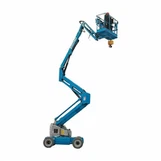
An Self Propelled Articulating Boom Lift has a series of joints that allow the arm to bend and move in multiple directions. This makes it ideal for reaching over obstacles or into tight spaces. The joints are usually hydraulic, which means they're powered by a hydraulic system that uses fluid pressure to move the arm.
The articulating boom arm is made up of several sections that can be extended or retracted to increase or decrease the reach of the lift. Each section is connected by a joint, which allows it to pivot and move independently. This gives the operator a lot of flexibility in positioning the platform.
Telescopic Boom Arm
A Self Propelled Telescopic Boom Lift has a single, straight arm that can be extended or retracted like a telescope. This makes it ideal for reaching high places quickly and easily. The telescopic boom arm is usually powered by a hydraulic system that uses a series of cylinders to extend and retract the arm.
The telescopic boom arm is made up of several nested sections that slide inside each other. When the arm is extended, the sections are pushed out one by one, increasing the reach of the lift. When the arm is retracted, the sections slide back inside each other, reducing the overall length of the arm.
Platform
The platform is where the operator stands or sits while using the boom lift. It's usually located at the end of the boom arm and is designed to provide a safe and stable working environment. The platform is typically made of steel or aluminum and is equipped with safety features such as guardrails and harness attachment points.
The size and capacity of the platform can vary depending on the type of boom lift. Some platforms are small and designed for one or two people, while others are larger and can accommodate several workers and their equipment. The platform is also equipped with controls that allow the operator to move the boom lift up, down, left, and right.
Power Source
Boom lifts can be powered by a variety of sources, including gasoline, diesel, electric, or hybrid. The type of power source used depends on the specific application and the requirements of the job.
Gasoline and Diesel Engines
Gasoline and diesel engines are commonly used in boom lifts because they provide a lot of power and are suitable for outdoor use. These engines are typically located in the base of the lift and are connected to the hydraulic system that powers the boom arm and other components.
Gasoline engines are generally lighter and more compact than diesel engines, which makes them a good choice for smaller boom lifts. Diesel engines, on the other hand, are more powerful and fuel-efficient, which makes them a better choice for larger boom lifts and heavy-duty applications.
Electric Motors
Self Propelled Electric Articulating Boom Lift are becoming increasingly popular because they're quieter, more environmentally friendly, and require less maintenance than gasoline or diesel engines. Electric motors are typically powered by a battery pack that can be recharged using a standard electrical outlet.
Electric boom lifts are ideal for indoor use because they don't produce any emissions. They're also more energy-efficient than gasoline or diesel engines, which can save you money on fuel costs over time. However, the range of an electric boom lift is limited by the battery life, so it's important to choose a lift with a battery that can provide enough power for your needs.
Hybrid Systems
Hybrid boom lifts combine the benefits of gasoline or diesel engines with the benefits of electric motors. These lifts typically have a small gasoline or diesel engine that's used to charge the battery pack and power the hydraulic system. The electric motor is then used to power the boom arm and other components.


Hybrid boom lifts are a good choice for applications that require a lot of power but also need to be environmentally friendly. They're also more fuel-efficient than gasoline or diesel engines, which can save you money on fuel costs over time.
Controls and Safety Systems
Boom lifts are equipped with a variety of controls and safety systems to ensure the safety of the operator and the people working around the lift. The controls allow the operator to move the boom lift up, down, left, and right, as well as extend and retract the boom arm.
The safety systems on a boom lift include features such as overload sensors, tilt sensors, and emergency stop buttons. The overload sensors are designed to detect when the lift is carrying too much weight and will automatically shut down the lift to prevent it from tipping over. The tilt sensors are designed to detect when the lift is tilting too far and will also automatically shut down the lift to prevent it from tipping over.
The emergency stop buttons are located on the platform and the base of the lift and can be used to immediately stop the lift in case of an emergency. In addition, boom lifts are usually equipped with safety harnesses and lanyards that the operator must wear to prevent them from falling off the platform.
Conclusion
So, there you have it! Those are the main parts of a boom lift. As you can see, these machines are complex and sophisticated pieces of equipment that require a lot of engineering and design to ensure their safety and reliability.
If you're in the market for a boom lift, I'd be happy to help you find the right one for your needs. Whether you're looking for an articulating boom lift, a telescopic boom lift, or an electric boom lift, I have a wide range of options to choose from. Just give me a call or send me an email, and we can start discussing your requirements.
Thanks for reading!
References
- OSHA. (2023). Powered industrial trucks. Retrieved from https://www.osha.gov/pit
- ANSI. (2022). American national standard for mobile elevating work platforms. Retrieved from https://www.ansi.org/