As a supplier of JK - D planetary winches, I understand the importance of accurately measuring the performance parameters of these essential pieces of equipment. JK - D planetary winches are widely used in various industries such as construction, mining, and marine, where reliable and efficient operation is crucial. In this blog, I will share some key methods and considerations for measuring the performance parameters of JK - D planetary winches.
1. Lifting Capacity
The lifting capacity is one of the most critical performance parameters of a winch. It refers to the maximum weight that the winch can safely lift. To measure the lifting capacity of a JK - D planetary winch, we can use a calibrated load cell.
First, set up the winch in a safe and stable environment. Attach the load cell between the winch hook and the test load. Gradually increase the load on the winch until it reaches its maximum designed capacity or until the winch shows signs of stress or malfunction. During the process, record the readings from the load cell at regular intervals.
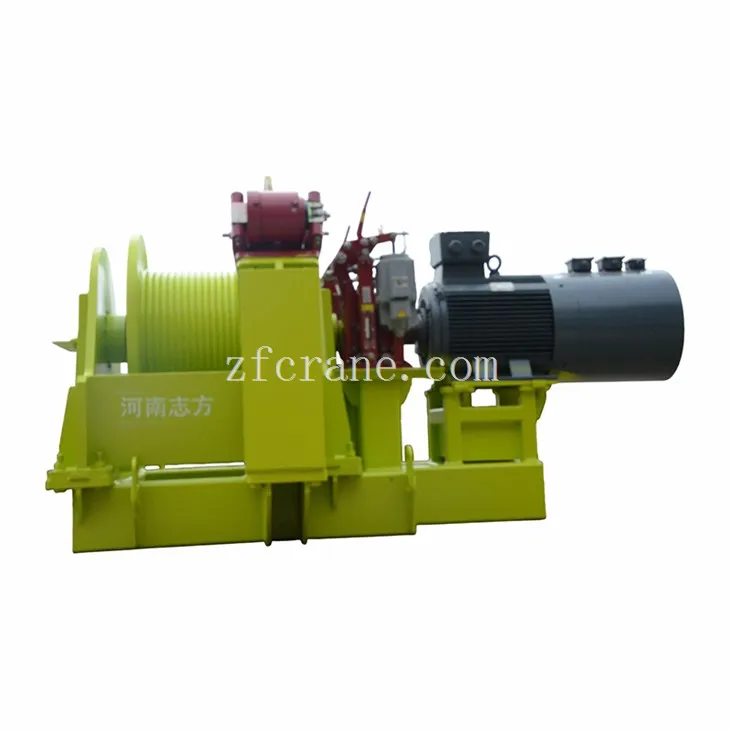

It is important to note that the lifting capacity can be affected by factors such as the length of the rope, the number of rope layers on the drum, and the operating speed. For example, as the rope layers increase on the drum, the effective diameter of the drum changes, which can impact the lifting force. Therefore, when measuring the lifting capacity, we should follow the manufacturer's guidelines regarding the rope configuration and operating conditions.
2. Lifting Speed
The lifting speed of a JK - D planetary winch is another important parameter. It is defined as the rate at which the winch can lift the load vertically. To measure the lifting speed, we can use a combination of a stop - watch and a measuring tape.
Mark a reference point on the load or the lifting path. Start the winch and simultaneously start the stop - watch. When the load has been lifted a certain distance (for example, 10 meters), stop the stop - watch. Calculate the lifting speed by dividing the distance by the time taken.
However, the lifting speed is not constant throughout the lifting process. It can vary depending on the load weight. Generally, as the load increases, the lifting speed decreases due to the increased resistance. So, it is advisable to measure the lifting speed at different load levels to get a comprehensive understanding of the winch's performance.
3. Rope Pulling Force
The rope pulling force is the force exerted by the winch on the rope to move the load. We can measure the rope pulling force using a dynamometer.
Attach the dynamometer to the rope between the winch and the load. Start the winch and gradually increase the load on the winch. As the winch operates, the dynamometer will display the pulling force. Record the pulling force values at different load levels.
The rope pulling force is related to the motor power, gear ratio, and the efficiency of the winch's transmission system. A well - designed JK - D planetary winch should be able to provide a sufficient pulling force to handle the intended loads. If the measured pulling force is lower than the specified value, it may indicate problems such as a worn - out gearbox or a malfunctioning motor.
4. Drum Capacity
The drum capacity refers to the maximum length of the rope that the winch drum can hold. To measure the drum capacity, we can measure the dimensions of the drum, including its diameter and width.
The formula for calculating the approximate drum capacity is based on the cross - sectional area of the rope and the available space on the drum. First, measure the inner diameter ($D_1$) and outer diameter ($D_2$) of the drum and its width ($W$). The volume of the space on the drum for the rope is given by $V=\pi\times\frac{(D_2^2 - D_1^2)}{4}\times W$.
Then, divide the volume by the cross - sectional area of the rope ($A$) to get the approximate length of the rope that the drum can hold. However, in practice, we also need to consider factors such as the rope's winding pattern and the minimum clearance required between the rope layers.
5. Motor Power and Efficiency
The motor is the power source of the JK - D planetary winch. Measuring the motor power accurately is essential for evaluating the winch's overall performance. We can use a power analyzer to measure the electrical power input to the motor.
The power analyzer can measure parameters such as voltage, current, and power factor. By multiplying the voltage, current, and power factor, we can obtain the electrical power input to the motor. To measure the efficiency of the motor, we need to compare the mechanical power output (which can be estimated from the lifting capacity and lifting speed) with the electrical power input.
The efficiency of the motor is affected by factors such as the motor design, load level, and operating temperature. A high - efficiency motor can reduce energy consumption and operating costs.
6. Brake Performance
The brake system of a JK - D planetary winch is crucial for safety. To measure the brake performance, we can conduct a static load test.
Apply a load to the winch that is close to its maximum lifting capacity. Engage the brake and check if the load remains stationary. If the load starts to move, it indicates that the brake is not functioning properly.
We can also measure the braking torque using a torque wrench. This involves applying a known torque to the brake disc or drum and checking if the brake can hold the torque without slipping.
7. Noise and Vibration Levels
Excessive noise and vibration can indicate problems with the winch's mechanical components or improper installation. To measure the noise level, we can use a sound level meter. Place the sound level meter at a fixed distance from the winch (usually 1 meter) and measure the noise level during winch operation at different load levels.
For vibration measurement, we can use a vibration sensor. Mount the vibration sensor on the winch's frame or other critical components and record the vibration amplitude and frequency. High - frequency vibrations can cause premature wear of the components, while low - frequency vibrations may be related to misalignment or imbalance.
In conclusion, accurately measuring the performance parameters of JK - D planetary winches is essential for ensuring their safe and efficient operation. By using the appropriate measuring tools and following the correct procedures, we can identify any potential issues and make necessary adjustments or repairs.
If you are interested in our JK - D Planetary Electric Winch or JKD Electric Portable Planetary Drive Winch, please feel free to contact us for more information and to discuss your specific requirements. We are committed to providing high - quality winches and excellent customer service.
References
- Manufacturer's manuals of JK - D planetary winches
- Engineering textbooks on mechanical design and winch technology
- Industry standards for winch performance testing